
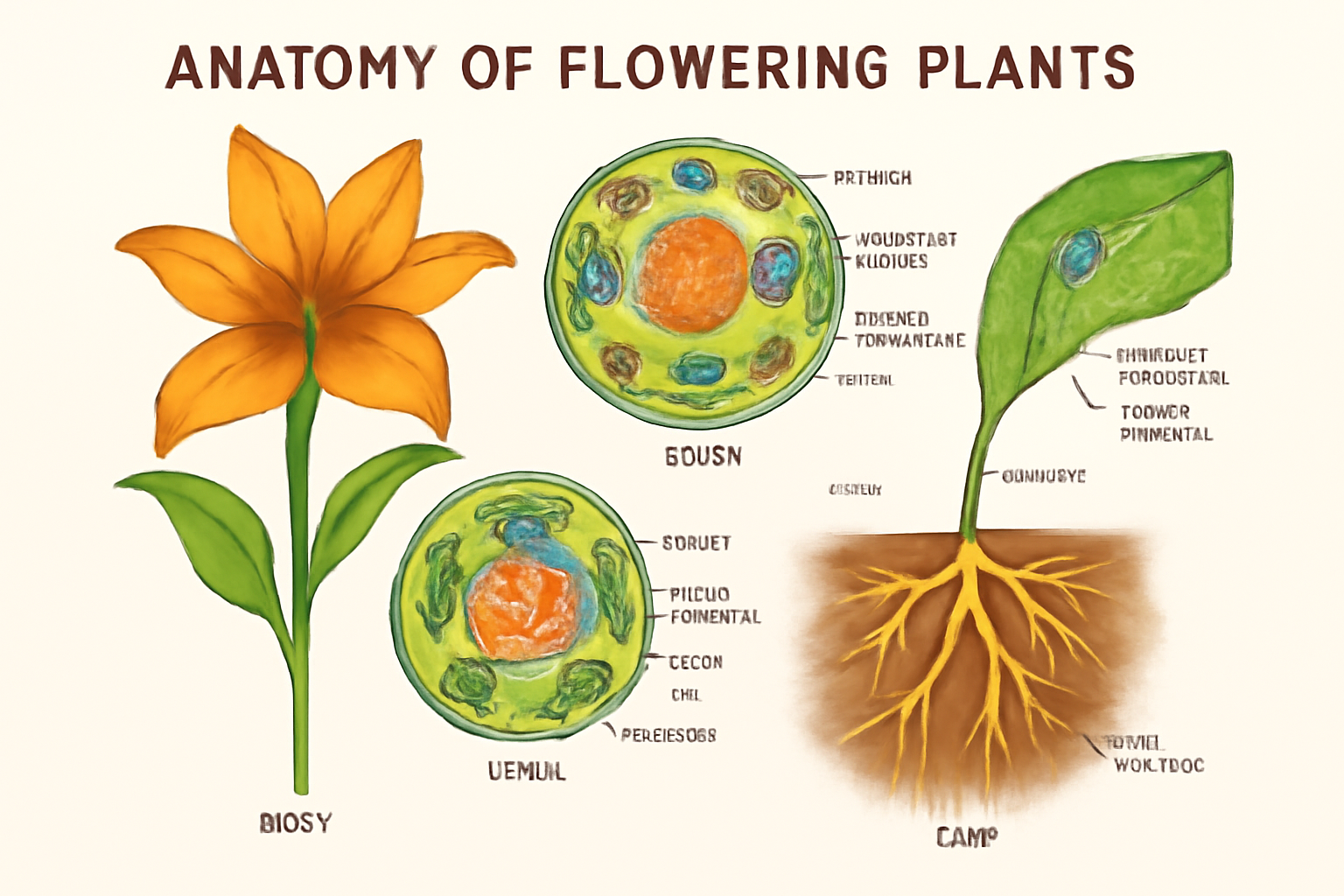
Class 11 Biology Chapter 6: Anatomy of Flowering Plants – 100 MCQs with Answers
1. Quiescent centre is present in:
Answer: D) Root meristem
2. Closed vascular bundles lack which of the following?
Answer: C) Cambium
3. Which of the following is not a feature of spring wood?
Answer: D) Lesser number of xylary elements
4. In monocot leaf, the mesophyll is:
Answer: C) Not differentiated
5. The innermost layer of cortex showing Casparian strips is:
Answer: B) Endodermis
6. Vessels differ from tracheids in:
Answer: C) Vertical row of cells with dissolved cross walls
7. Endodermis cells are rich in:
Answer: B) Starch grains
8. In dicot stem, open vascular bundles possess:
Answer: B) Cambium
9. The tissue forming wood in a tree trunk is:
Answer: D) Secondary xylem
10. Main function of companion cells is to:
Answer: B) Support sieve tubes
11. Sclerenchyma tissue functions primarily in:
Answer: C) Mechanical support
12. Which meristem increases girth of stems?
Answer: B) Lateral
13. Cambium found between xylem and phloem is:
Answer: B) Vascular cambium
14. Node and internode are found in:
Answer: C) Stem
15. Radial vascular bundles occur in:
Answer: C) Dicot root
16. Collenchyma cells are characterized by:
Answer: A) Thickened corners
17. The tissue system present between epiblema and pericycle in roots is:
Answer: A) Cortex
18. The main water-conducting tissue in angiosperms is:
Answer: B) Vessels
19. Formative tissue in a plant is:
Answer: A) Meristem
20. Which plant cell type is dead at maturity?
Answer: B) Sclerenchyma
21. The tissue not found in xylem is:
Answer: A) Sieve tube
22. Bulliform cells are present in:
Answer: A) Monocot leaves
23. Cork cambium is also called:
Answer: A) Phellogen
24. In monocot root, the vascular bundles are:
Answer: C) Polyarch
25. Heartwood differs from sapwood in:
Answer: B) Presence of resin
26. Epiblema is also called:
Answer: A) Epidermis
27. The term “vascular” refers to:
Answer: B) Conducting tissue
28. Vascular bundles of dicot stem are:
Answer: A) Conjoint, collateral, open
29. Pericycle gives rise to:
Answer: A) Lateral roots
30. Cork cells are rich in:
Answer: C) Suberin
31. Lenticels help in:
Answer: B) Aeration
32. Tyloses structures are associated with:
Answer: C) Heartwood
33. The main role of sieve tubes is:
Answer: C) Conduction of food
34. Collateral vascular bundles have:
Answer: B) Xylem inside, phloem outside
35. Apical meristem is found at:
Answer: C) Shoot tip
36. Periderm is composed of:
Answer: B) Cork, cork cambium, secondary cortex
37. Which zone of root is responsible for absorption?
Answer: B) Zone of maturation
38. The major component of primary cell wall is:
Answer: C) Cellulose
39. The leaf epidermis usually bears:
Answer: A) Trichomes
40. The region of root tip protected by root cap is called:
Answer: B) Meristematic zone
41. The tissue used for making jute ropes is:
Answer: C) Sclerenchyma
42. Polyarch vascular bundles are found in:
Answer: B) Monocot root
43. The hard, central region of tree trunk is:
Answer: B) Heartwood
44. The role of pith in stem is:
Answer: C) Store food
45. Bulliform cells are found in the _______ of monocot leaves.
Answer: B) Upper epidermis
46. Primary growth in plants increases:
Answer: A) Length
47. Periderm replaces _______ in older roots and stems.
Answer: C) Epidermis
48. Medullary rays are found in:
Answer: A) Vascular bundles
49. The main function of root hairs is:
Answer: B) Absorption of water
50. The xylem element found in gymnosperms but absent in angiosperms is:
Answer: B) Vessels
51. Growth in width of stem is due to:
Answer: B) Lateral meristem
52. The process of cork formation is called:
Answer: B) Phellogeny
53. Which induces secondary growth in dicot stem?
Answer: A) Vascular cambium
54. Xylem parenchyma is involved in:
Answer: C) Storage of food
55. Cork cells are waterproof due to:
Answer: C) Suberin
56. Cambium ring in dicot stem forms:
Answer: B) Xylem and phloem
57. Phloem in angiosperms contains:
Answer: A) Sieve tubes
58. Which is living at maturity?
Answer: C) Sieve tube
59. The main function of xylem vessel is:
Answer: B) Transport water
60. Open vascular bundles occur in:
Answer: B) Dicot stem
61. Growth of grass leaves is due to:
Answer: B) Intercalary meristem
62. Stele is the:
Answer: C) Central cylinder
63. The main function of parenchyma is:
Answer: B) Storage
64. Secondary growth occurs in:
Answer: C) Dicot stem
65. Cork is made of:
Answer: C) Suberized cells
66. Wound healing is promoted by:
Answer: A) Phellogen
67. The water-conducting tissue in gymnosperms is:
Answer: B) Tracheids
68. The tissue that forms the bark is:
Answer: A) Cork
69. Medullary rays function as:
Answer: C) Both A and B
70. In leaves, palisade parenchyma is present in:
Answer: B) Upper side
71. Girdling is done to:
Answer: C) Prevent conduction of food
72. Interxylary phloem is found in:
Answer: B) Cucurbita
73. The function of pericycle in roots is to:
Answer: A) Produce lateral roots
74. Veins in monocot leaves are:
Answer: C) Parallel
75. Xylem is not present in:
Answer: D) Cortex
76. Pith is most developed in:
Answer: C) Monocot stem
77. The ring of cambium appears in stems of:
Answer: D) Woody dicots
78. The tissue system which gives rise to periderm is:
Answer: D) Lateral meristem
79. Mitosis in meristem cells leads to:
Answer: C) Cell division
80. Spongy parenchyma is found in:
Answer: B) Lower mesophyll
81. Tracheids are absent in:
Answer: D) Bryophytes
82. The function of companion cells is associated with:
Answer: B) Sieve tubes
83. Endodermis always surrounds the:
Answer: B) Stele
84. Pericycle is found next to:
Answer: A) Endodermis
85. During secondary growth, periderm arises from:
Answer: B) Phellogen
86. The root hair increases:
Answer: A) Water absorption
87. Conjunctive tissue in roots is:
Answer: C) Parenchyma
88. Growth of stem occurs by:
Answer: A) Apical meristem
89. Sieve plates are associated with:
Answer: B) Sieve tubes
90. Bordered pits are characteristic feature of:
Answer: D) Tracheids
91. Casparian strip is found in:
Answer: A) Endodermis
92. The main function of lenticels is:
Answer: C) Gaseous exchange
93. The pericycle is generally:
Answer: A) Single layer
94. Wood is made up of:
Answer: A) Secondary xylem
95. Which tissue possesses sieve tubes?
Answer: B) Phloem
96. The cork cambium forms:
Answer: B) Cork and secondary cortex
97. The main function of tracheary elements is:
Answer: B) Conduction of water
98. The secondary growth in root is initiated by:
Answer: C) Pericycle
99. Isobilateral leaves are characteristic of:
Answer: B) Monocot plant
100. The tissue connecting xylem and phloem in leaf veins is:
Answer: A) Bundle sheath
End of MCQs.