
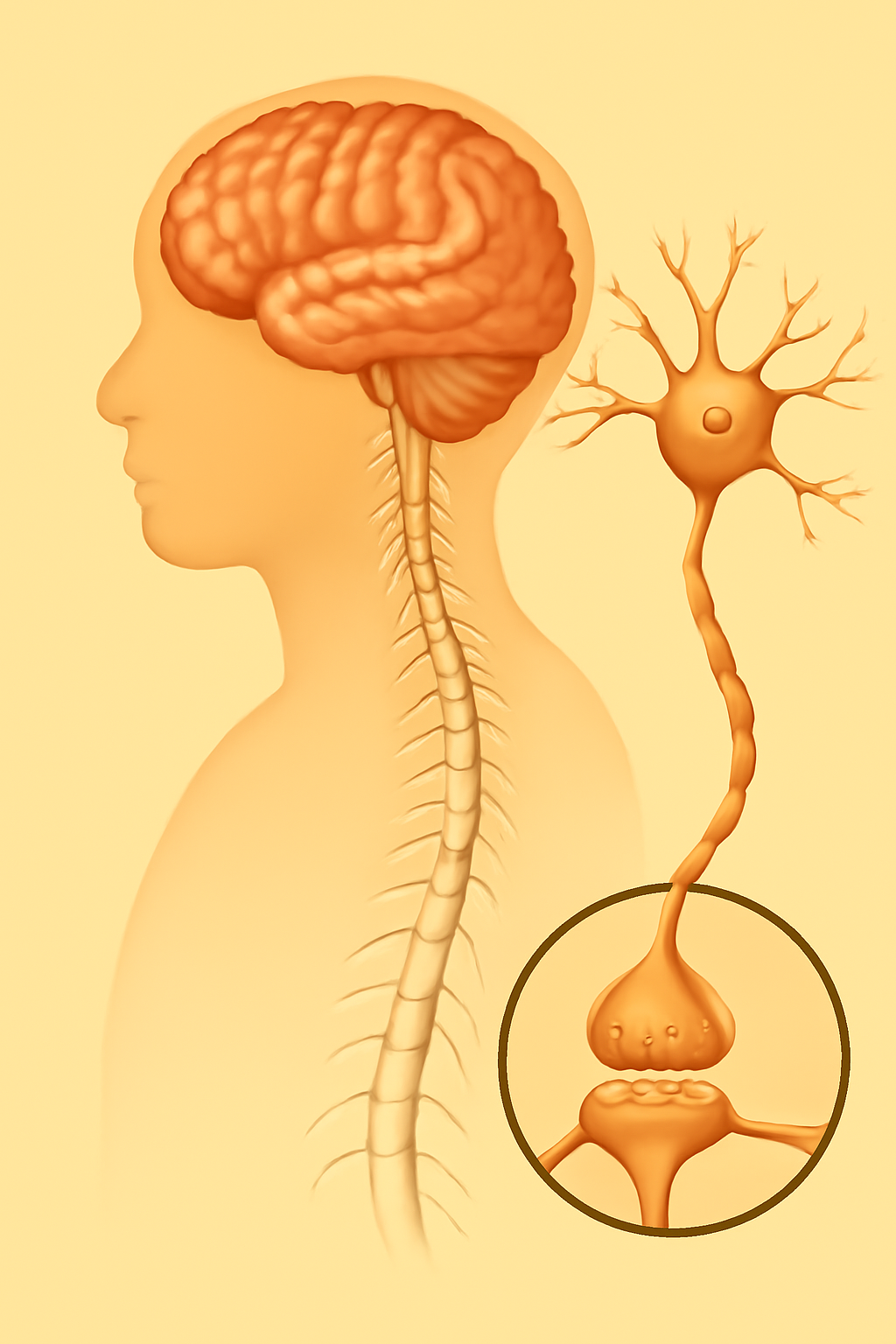
Class 11 Biology Chapter 21: Neural Control and Coordination – 100 MCQs with Answers
1. Structural and functional unit of nervous system is:
Answer: B) Neuron
2. Which part of neuron carries impulse away from cell body?
Answer: B) Axon
3. The gap between two neurons is called:
Answer: A) Synapse
4. Which neurons transmit impulses from CNS to effectors?
Answer: B) Motor
5. White matter in CNS consists of:
Answer: B) Myelinated axons
6. Myelin sheath in CNS is formed by:
Answer: B) Oligodendrocytes
7. Resting potential of neuron is around:
Answer: C) -70mV
8. Which ion is abundant outside the neuron at rest?
Answer: C) Na+
9. Nissl bodies are found in:
Answer: A) Cell body
10. The site of processing of neural information is:
Answer: C) CNS
11. Which cranial nerve is longest?
Answer: B) Vagus
12. Nerve impulse transmission is fastest in:
Answer: B) Myelinated fibre
13. Which part of brain controls respiration?
Answer: B) Medulla oblongata
14. Coordination in human body is controlled by:
Answer: D) All above
15. The functional junction between two neurons:
Answer: B) Synapse
16. Corpus callosum connects:
Answer: B) Left and right cerebral hemispheres
17. The part of brain responsible for intelligence:
Answer: B) Cerebrum
18. Which meninges is outermost?
Answer: B) Dura mater
19. Reflex actions are controlled by:
Answer: C) Spinal cord
20. Main function of cerebellum is:
Answer: C) Balance and coordination
21. Which of the following is NOT a type of neuron?
Answer: D) Bimodal
22. Gray matter of brain consists of:
Answer: B) Dendrites and cell bodies
23. The neurotransmitter at neuromuscular junction:
Answer: B) Acetylcholine
24. The brain is protected by:
Answer: D) Both A and C
25. How many pairs of cranial nerves are there in humans?
Answer: A) 12
26. Nerve impulse is:
Answer: C) Both
27. Spinal cord ends at:
Answer: A) Lumbar 1
28. Node of Ranvier is:
Answer: B) Gap in myelin sheath
29. Connecting link between nervous and endocrine systems:
Answer: B) Hypothalamus
30. Cerebrospinal fluid is secreted by:
Answer: B) Choroid plexus
31. Which is not a function of spinal cord?
Answer: C) Judgement
32. Sympathetic and parasympathetic systems form:
Answer: B) Autonomic NS
33. Fight or flight response is due to:
Answer: B) Sympathetic NS
34. Which lobe of cerebrum is for visual area?
Answer: D) Occipital
35. Auditory area is located in:
Answer: C) Temporal lobe
36. Connecting link between two neurons is:
Answer: A) Synapse
37. Polarized membrane is characterized by:
Answer: C) Sodium outside Potassium inside
38. Inhibition of impulse at synapse is due to:
Answer: B) GABA
39. Pacinian corpuscle is:
Answer: B) Mechanoreceptor
40. The neurotransmitter for pain suppression:
Answer: B) Endorphin
41. The part of neuron that receives stimulus:
Answer: B) Dendrite
42. Least developed part of human brain:
Answer: B) Midbrain
43. The brain part involved in maintaining posture:
Answer: B) Cerebellum
44. Rest and digest actions are of:
Answer: A) Parasympathetic NS
45. Consciousness is lost if which part is damaged?
Answer: D) Cerebrum
46. Schwann cell forms myelin in:
Answer: B) PNS
47. The main function of hypothalamus:
Answer: B) Temperature regulation
48. The area for speech in brain is:
Answer: B) Broca’s
49. Outer layer of cerebrum is:
Answer: C) Cortex
50. Speed of TV viewing is controlled by:
Answer: B) Occipital lobe
51. Cranial nerves originate from:
Answer: A) Brain
52. Spinal nerves in humans:
Answer: C) 31 pairs
53. Sensory neurons are:
Answer: A) Afferent
54. All-or-none law relates to:
Answer: B) Nerve impulse
55. Type of conduction in myelinated fibre:
Answer: B) Saltatory
56. Reticular formation is part of:
Answer: B) Brainstem
57. Which is a mixed nerve?
Answer: C) Spinal
58. The dorsal root of spinal nerve is:
Answer: A) Sensory
59. Outermost covering of nerve:
Answer: B) Epineurium
60. White matter is white due to:
Answer: B) Myelin
61. Which area in brain is sensory relay centre?
Answer: C) Thalamus
62. Eustachian tube connects:
Answer: C) Pharynx–middle ear
63. If occipital lobe is damaged:
Answer: B) Vision lost
64. Autonomic nervous system regulates:
Answer: B) Involuntary act
65. Saltatory conduction means:
Answer: A) Jumping node-node
66. Sciatic nerve originates from:
Answer: D) Sacral plexus
67. The attention and alertness is due to:
Answer: C) Reticular formation
68. Inner ear contains:
Answer: D) All
69. Fluid in semicircular canals:
Answer: B) Endolymph
70. Memory area in cerebrum:
Answer: D) Temporal
71. Coordination between two sensory areas is by:
Answer: B) Association area
72. The “crossing over” of nerve fibres is:
Answer: B) Medulla
73. Loss of memory is:
Answer: B) Amnesia
74. Fight or flight response hormone:
Answer: A) Adrenaline
75. Cranium encloses:
Answer: B) Brain
76. The iris regulates:
Answer: A) Entry of light
77. Fovea centralis is:
Answer: C) Area of most acute vision
78. Retina contains:
Answer: D) All
79. Accommodation of lens is function of:
Answer: A) Ciliary body
80. Impulse from retina to brain by:
Answer: A) Optic nerve
81. Photosensitive pigment in rods:
Answer: A) Rhodopsin
82. Tympanic membrane is:
Answer: B) Ear drum
83. Sense of smell is by:
Answer: A) Olfactory nerve
84. Crista detects:
Answer: D) Both B and C
85. Structure responsible for equilibrium:
Answer: B) Crista and macula
86. Presbyopia occurs due to:
Answer: A) Ageing
87. Taste buds are present on:
Answer: D) All
88. Blind spot is:
Answer: B) Optic disc
89. Ear ossicles transmit:
Answer: B) Vibrations
90. Shape of lens is changed by:
Answer: B) Ciliary muscles
91. Which sense is most closely linked to memory?
Answer: B) Smell
92. Impulse conduction in nerve is possible due to:
Answer: C) Electrolytes
93. Lens used to correct myopia:
Answer: B) Concave
94. Part of ear involved in hearing:
Answer: A) Cochlea
95. Color vision is due to:
Answer: B) Cones
96. “Runner’s high” is due to:
Answer: B) Endorphins
97. Parkinson’s disease is due to lack of:
Answer: C) Dopamine
98. The relay station for sensory impulses:
Answer: B) Thalamus
99. Organ of Corti is present in:
Answer: A) Cochlea
100. Number of rods per eye (approx):
Answer: D) 120 million