
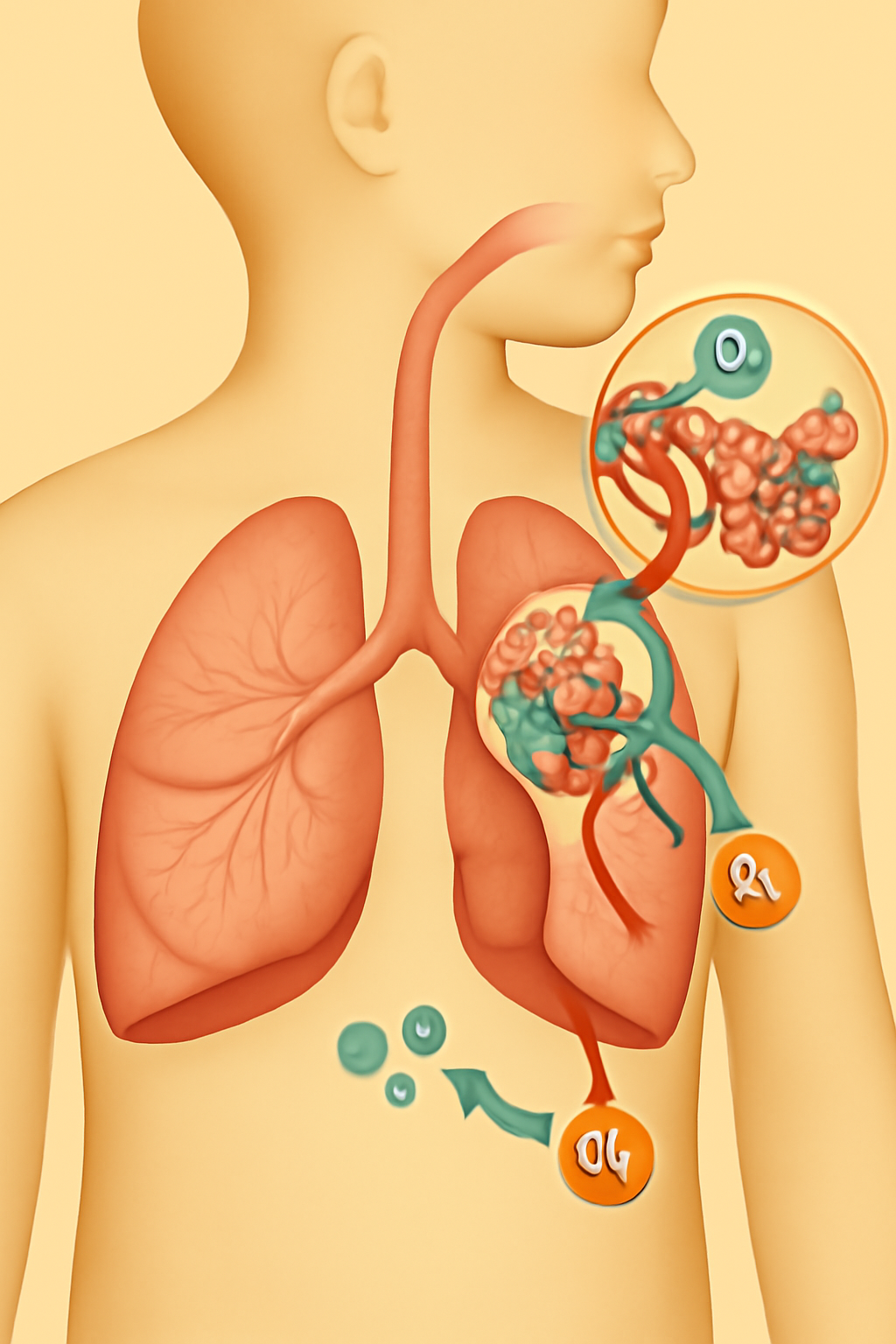
Class 11 Biology Chapter 17: Breathing and Exchange of Gases – 100 MCQs with Answers
1. The percentage of oxygen in inhaled air is:
Answer: B) 21%
2. The reserve volume of air left after normal expiration is:
Answer: C) Expiratory reserve
3. The functional unit of lungs is:
Answer: B) Alveolus
4. The major site of gaseous exchange in lungs is:
Answer: C) Alveoli
5. The total lung capacity is:
Answer: C) 5800ml
6. Exchange of gases in the alveoli occurs by:
Answer: B) Simple diffusion
7. Human respiratory pigment is:
Answer: C) Haemoglobin
8. Normal respiratory rate in healthy adult is:
Answer: C) 12-16/min
9. Oxygen is transported mostly as:
Answer: B) As oxyhaemoglobin
10. Bohr Effect refers to:
Answer: B) Impact of CO2 on O2 binding
11. The volume of air exchanged in and out during normal breathing:
Answer: A) Tidal volume
12. Control of respiration in CNS is located in:
Answer: B) Medulla oblongata
13. Maximum exchange of gases occurs at:
Answer: C) Alveoli
14. Carbaminohaemoglobin forms when:
Answer: B) CO2 combines with Hb
15. The primary force that causes inspiration is:
Answer: A) Expanding diaphragm
16. Oxygen dissociation curve of haemoglobin is:
Answer: B) Sigmoid
17. Main form of CO2 transport in blood:
Answer: C) Bicarbonate ions
18. CO binds with haemoglobin to form:
Answer: C) Carboxyhaemoglobin
19. In emphysema, the damage is to:
Answer: C) Alveolar walls
20. Holding breath for long increases:
Answer: B) CO2 in blood
21. The percentage of CO2 carried as bicarbonate:
Answer: C) 70%
22. Instrument to measure breathing movements:
Answer: C) Spirometer
23. Chloride shift refers to:
Answer: A) HCO3- exchange for Cl-
24. Respiratory volume more than tidal volume:
Answer: A) Inspiratory reserve
25. The fine tubes in lungs before alveoli:
Answer: B) Bronchioles
26. Hypercapnia means:
Answer: B) CO2 excess
27. Apnoea is:
Answer: B) Temporary cessation of breathing
28. Partial pressure of O2 in alveoli is:
Answer: A) 104mmHg
29. Total number of lobes in human lungs:
Answer: A) 5
30. In lungs, air is filtered by:
Answer: A) Cilia
31. Surfactant function in alveoli:
Answer: B) Decrease surface tension
32. During swallowing, opening to respiratory tract is closed by:
Answer: C) Epiglottis
33. Larynx is also known as:
Answer: A) Voice box
34. Respiratory quotient (RQ) for carbohydrate is:
Answer: B) 1
35. The cartilage present in trachea:
Answer: C) Hyaline cartilage
36. 97% of oxygen is transported:
Answer: C) By haemoglobin
37. Hypoxia means:
Answer: B) Low O2
38. In asthma, problem is with:
Answer: B) Narrowing of bronchi
39. Oxygen is released from haemoglobin when:
Answer: C) High pCO2
40. Increase in H+ in blood causes:
Answer: A) Increase in breathing rate
41. Pneumotaxic center is present in:
Answer: B) Pons
42. True vocal cords are found in:
Answer: B) Larynx
43. Carbon monoxide poisoning is dangerous because:
Answer: A) High affinity for Hb
44. The trachea divides into:
Answer: A) Bronchi
45. Lungs are covered by:
Answer: C) Pleura
46. An adult human has how many alveoli (approx):
Answer: C) 300 million
47. Histamine causes:
Answer: A) Bronchoconstriction
48. Normal pCO2 of arterial blood (mmHg):
Answer: B) 40
49. O2 affinity of foetal Hb is:
Answer: C) Higher
50. Most powerful stimulus for breathing:
Answer: B) High CO2
51. Vital capacity is:
Answer: C) IRV + ERV + TV
52. The disease ‘silicosis’ affects:
Answer: A) Alveoli
53. Anoxia means:
Answer: B) Lack of O2
54. Minute ventilation (adults) per min (approx):
Answer: C) 6L
55. Hering-Breuer reflex is:
Answer: D) All above
56. DPG in RBCs causes:
Answer: A) Increased O2 release
57. Cigarette smoking can lead to:
Answer: D) All above
58. If tidal volume is 500ml, breathing rate 12/min, minute volume is:
Answer: B) 6000ml
59. Larynx is placed:
Answer: A) Upper trachea
60. Non-respiratory function of lungs is:
Answer: C) Modify blood pH
61. Site of respiratory membrane is:
Answer: A) Alveolar wall
62. Bulk of CO2 formed in tissue is carried as:
Answer: C) Bicarbonate
63. Right lung has how many lobes?
Answer: C) 3
64. During inspiration, thoracic cavity:
Answer: B) Becomes larger
65. The narrowest part of respiratory passage:
Answer: B) Glottis
66. In mammals, lungs are:
Answer: C) Partitioned
67. Enzyme converting CO2 to HCO3- in RBC:
Answer: B) Carbonic anhydrase
68. Chemoreceptors sensitive to blood pH are located in:
Answer: C) Both
69. Oxygen-haemoglobin dissociation curve is shifted to right by:
Answer: B) High temp
70. Maximum solubility of CO2 occurs in:
Answer: A) Plasma
71. Master controller of respiration is:
Answer: B) Medulla
72. Diffusion of gases across alveolar membrane depends on:
Answer: D) All above
73. Trachea is supported by:
Answer: A) C-shaped cartilage
74. Larynx is protected by:
Answer: C) Both
75. Partial pressure of CO2 in tissue capillaries:
Answer: C) 45mmHg
76. A molecule of oxyhaemoglobin can carry:
Answer: C) 4 O2
77. In high altitude, what decreases in blood?
Answer: B) Oxygen saturation
78. Respiratory distress syndrome in newborn is due to:
Answer: A) Lack of surfactant
79. Residual volume helps in:
Answer: A) Constant gaseous exchange
80. Cough reflex is initiated in:
Answer: B) Trachea
81. Asphyxia means:
Answer: B) Lack of O2
82. Inspiratory reserve volume is:
Answer: B) 3000ml
83. Expiratory reserve volume is:
Answer: B) 1100ml
84. Residual volume in adult is:
Answer: C) 1200ml
85. Cheyne-Stokes breathing is:
Answer: A) Cyclic breathing
86. Cyanosis is due to:
Answer: C) Less O2
87. Most O2 delivered to tissues is due to:
Answer: D) Bohr effect
88. Haemoglobin is a:
Answer: A) Protein
89. Boyle’s Law relates to:
Answer: B) Pressure and volume
90. Gaseous exchange in lungs depends on:
Answer: D) All above
91. Movement of O2 from alveoli to blood occurs via:
Answer: C) Simple diffusion
92. The first step in inspiration is:
Answer: A) Diaphragm contracts
93. The protein part of haemoglobin is:
Answer: B) Globin
94. Which has maximum O2 carrying capacity?
Answer: A) Arterial blood
95. The pH of blood is:
Answer: B) 7.4
96. Lungs do not collapse due to:
Answer: B) Negative intrapleural pressure
97. Most of oxygen is carried in blood by:
Answer: B) Haemoglobin
98. The amount of O2 per 100ml of blood is:
Answer: B) 20ml
99. Which statement about breathing is true?
Answer: B) Inspiration always active
100. Exchange of gases between blood and tissue is:
Answer: A) Internal respiration